

The Practice Level Support (PLS) programme facilitated by NECS Digital Transformation & Optimisation Service (DTOS) involved 12 on-site visits to enrolled GP practices by a Facilitator. The programme gave the opportunity to assess GP practice websites. Traditionally, this assessment could be done using NHS England’s usability and accessibility guidelines or by using an Excel-based benchmarking tool, also issued by NHS England.
Instead, by using Copilot to analyse homepage screenshots in desktop and mobile views, a significant reduction in assessment time compared to manual reviews was achieved, enabling faster support for practices.
The challenge
GP practice websites are an important patient access point, but there are websites that do not meet NHS England’s usability and accessibility standards. NHS research highlighted that patients use GP practice websites for core tasks such as making or changing appointments, requesting repeat prescriptions, getting sick notes, accessing test results, registering with a practice, and finding contact details like phone number, opening times, and address.
Traditionally, assessments of GP practice websites relied on manual reviews or an Excel-based benchmarking tool, which were time-consuming. Such assessments were also subjective, with levels of compliance open to interpretation. This slowed down the PLS Facilitators ability to identify any issues and highlight improvements to these vital journeys quickly.
The solution
Copilot is a conversational AI assistant that is part of Microsoft 365 and is used in the NHS to helps users with tasks, streamline workflows and automate routine actions.
The Facilitator used Copilot’s AI capabilities to assess GP practice website homepages. Screenshots of each site in desktop and mobile view were uploaded, and Copilot analysed them against NHS England’s guide, Creating a highly usable and accessible GP website for patients. This automated approach replaced manual assessments and Excel-based benchmarking, reducing complexity and improving consistency. The process was simple: capture screenshots, upload them to Copilot, and receive structured feedback aligned with standards.
Copilot was asked “Using the guide in this URL, please assess this home page in desktop and mobile views https://www.england.nhs.uk/long-read/creating-a-highly-usable-and-accessible-gp-website-for-patients/”.
This innovation allowed the Facilitator to complete assessments in minutes rather than hours, freeing up time for direct support to practices in other areas.
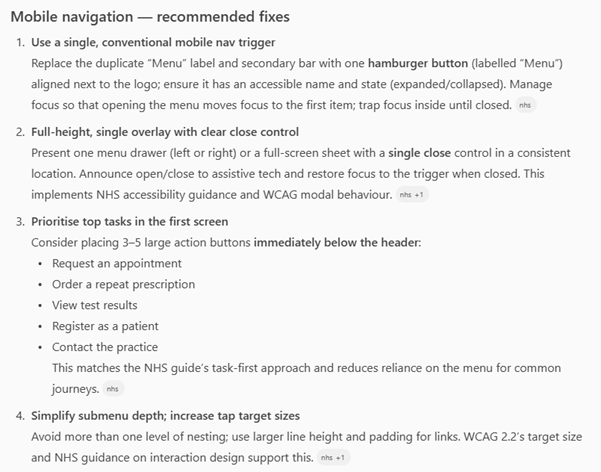
Sample of a Copilot generated home page assessment, showing recommended fixes

The results
The AI-based assessment saved a lot of time and focused on the things that matter most to patients. It concentrated on the main tasks patients choose to complete on a website, such as booking or changing appointments, ordering repeat prescriptions, getting sick notes and test results, registering with the practice, and finding contact details. This meant that any improvements were aimed at the areas with the biggest impact.
Manual reviews usually take 30–60 minutes per website, but Copilot completed each assessment in well under 5 minutes. It quickly highlighted where websites were not meeting expectations for these key tasks. This freed up the PLS Facilitator’s limited time to focus on other parts of the programme.
|
Method |
Average Time |
Time Saved |
Efficiency Gain |
|
Manual Review |
30–60 mins |
0 mins |
Baseline |
|
Copilot-Assisted |
5–10 mins |
25–55 mins |
≈83% |
Time saved using Copilot for home page assessments
- The feedback provided was clear, practical, and consistent with NHS England standards, helping to keep assessments impartial.
- Practices received results more quickly along with focused recommendations, which could help improve patient access and experience.
- Overall, this showed how digital tools can speed up assessments and support improvements to patient journeys in the PLS programme.
Find out more
Email us at necsu.wearedtos@nhs.net or find out more at https://bit.ly/4kRt9L4
“Using Copilot transformed my assessment workflow. What used to take hours now takes minutes, allowing me to give more time to other areas where practices require support.”